
The World Health Organization (WHO) has confirmed an unprecedented Hantavirus outbreak on the MV Hondius, a Dutch-flagged polar expedition cruise ship operated by Oceanwide Expeditions, which left Ushuaia, Argentina, on April 1, 2026, en route to Cape Verde via Antarctica, the Falkland Islands, and Saint Helena1. By early May 2026, multiple laboratory-confirmed cases had been identified among passengers and crew from 23 nationalities, including three fatalities and several critically ill patients requiring international medical evacuation2,3. Exposed passengers subsequently dispersed across Europe, North America, Africa, and Asia, triggering a complex multinational public health response. To our knowledge, this represents the first documented hantavirus outbreak associated with a passenger cruise vessel. Passengers boarded the Hondius in Ushuaia, Argentina, an Andes virus-endemic region. Hantavirus occurs in Patagonia and Northern Argentina. Ushuaia, an island at the southernmost part of the country, has not been noted as a common location for hantavirus. The index case had travelled for 125 days with his wife in Argentina, Chile and Uruguay before the cruise, and may have acquired infection in the two months before boarding, most likely in Argentina, where they had spent the most time during the longest potential incubation period of two months.
The outbreak is notable not only because of the rarity and severity of hantavirus infection, but because it exposes important limitations in maritime outbreak preparedness and the risk of secondary cases occurring in 23 countries following dispersal of travellers back home. The global reconstruction of cruise infection-control systems following the SARS-CoV-2 pandemic focused primarily on highly transmissible respiratory viruses with rapid diagnostic pathways and well-characterised transmission dynamics4. The Hondius outbreak demonstrates that these systems remain poorly adapted to rare, high-consequence pathogens with prolonged incubation periods, variable human-to-human transmissibility, limited diagnostic availability, and potentially high case-fatality rates.
The Andes strain of hantavirus has been confirmed as the cause of the outbreak2. Argentina experienced higher than usual hantavirus activity during the 2025-2026 season, with the Ministry of Health describing activity as “above the outbreak threshold” and “showing a sustained increase”. EPIWATCH®, an AI-driven epidemic intelligence platform that analyses open-source infectious disease reports in 50 languages, identified hantavirus among the leading outbreak signals reported in Argentina over the preceding two years5 (Figure 1). Open-source epidemic intelligence can enhance situational awareness and inform travel medicine and maritime risk assessment. Expedition cruise itineraries increasingly traverse regions experiencing zoonotic spillover events, yet voyage planning rarely incorporates dynamic outbreak intelligence into operational preparedness frameworks.
Figure 1:Top ten diseases reported in EPIWATCH® in Argentina since 2024, showing rising reports of hantavirus outbreaks in 2025.
The index patient reportedly developed symptoms five days after departure from Argentina. Given the typical incubation period for hantavirus infection, exposure most likely occurred before embarkation, potentially during birdwatching in a rodent-contaminated area in Ushuaia, Tierra del Fuego, Argentina, although local health authorities denied this. Subsequent illness reported among close contacts, including the patient’s wife and ship’s crew (including a doctor), made it clear human-to-human transmission was occurring, with the Andes virus being the only strain documented to spread between people. During the 2018 epidemic of Clade 2 Andes virus, the R0 was estimated at 2.12, declining below one only after non-pharmaceutical interventions such as contact tracing, quarantine and case isolation were commenced6. This outbreak is characterized as Clade 3.
Cruise ships have long been recognised as efficient amplifiers of communicable disease. Between 1970 and 2003, at least 100 documented gastrointestinal and respiratory outbreaks were reported aboard cruise vessels, predominantly caused by norovirus, Legionella spp., Salmonella spp., and influenza A and B, with transmission via person-to-person, foodborne, waterborne, airborne, and shore-excursion routes7. A systematic review of outbreaks occurring between 1990 and 2019 identified 115 outbreaks and 7 single case reports with 82% of cases occurring among the crew members8. The key issues identified were high passenger density, shared ventilation and water systems, communal dining, multinational origin of crew and passengers, and frequent port turnover that reseeds susceptible cohorts7,8. Crew members typically working extended contracts, sharing cabins, and traversing both back-of-house and guest areas, function as persistent transmission bridges between voyages, as demonstrated in a 2023 multi-voyage norovirus outbreak in which the index case was a crew member during voyage 1, with onward transmission identifiable through voyages 2-59. Whilst passengers disembark after their cruise is over, staff with infection typically work across more than one cruise, and may act to continue transmission from one cruise to the next. In the case of hantavirus, the long incubation period may put subsequent cruises at risk if crew are retained rather than temporarily replaced while they undergo quarantine.
The revised International Health Regulations (IHR 2005) require ships to submit a Maritime Declaration of Health before arrival at the next port of call when any unusual health event occurs10. Operationally, however, IHR enforcement varies, and surveillance programmes such as the US CDC Vessel Sanitation Programme, EU SHIPSAN, and the EU Horizon-funded HEALTHY SAILING consortium have focused almost exclusively on gastroenteritis surveillance, with an attack-rate trigger calibrated to norovirus dynamics9-11. These thresholds are insufficient for severe, low-incidence pathogens such as hantavirus, where a single case or cluster of severe respiratory illness should constitute a notifiable event regardless of attack rate.
The COVID-19 pandemic transformed our understanding of confined-environment transmission. In Australia, cruise ship cases were directly linked to COVID-19 transmission and cruise ship passengers made up 14.9% of COVID-19 cases and 27% of the COVID-19 related deaths by mid 202012. In the 2020 Diamond Princess outbreak of 3711 passengers and crew, 712 (19%) became infected with SARS-CoV-2 despite implementation of cabin quarantine on day 7 of the voyage; approximately half of the confirmed cases were asymptomatic at diagnosis, and onward transmission continued throughout quarantine13,14. Mechanistic transmission modelling subsequently demonstrated that airborne transmission, rather than fomite or large-droplet routes, was the dominant pathway, with shared HVAC recirculation between adjacent cabins implicated as a key amplifier15. At the time, the WHO and other agencies denied both airborne and asymptomatic transmission of the virus. Asymptomatic transmission is now understood to be a major feature of SARS-CoV-2, making outbreak control difficult16. Three operational failures were repeatedly identified: continued working of crew with documented exposure to the index case, some of whom may have had asymptomatic infection; inadequate physical zoning between contaminated and clean areas; and reliance on symptom-based screening (fever ≥37·5°C) in an infection where presymptomatic and asymptomatic shedding predominated13,14. Subsequent analysis of US Public Health Travel Restrictions used during the Diamond Princess response highlighted further weaknesses in the international evacuation framework, particularly the absence of pre-agreed protocols for repatriating exposed but asymptomatic passengers that may still be within the incubation period across multiple jurisdictions17. These observations of the effects of asymptomatic transmission are relevant to the current situation, as the hantavirus expert group statement on the cruise ship outbreak states that asymptomatic transmission cannot be ruled out18. In fact, at least two cases tested positive whilst asymptomatic in this outbreak.
Two limitations of the COVID-19-era response are pertinent to the Hondius situation. First, entire cruise infection-control protocols, which were rebuilt after 2020 to address enhanced ventilation, hand hygiene reinforcement, isolation protocols, personal protective equipment and respiratory pathogen panels, were designed against a respiratory virus with rapid human-to-human spread19,20. Because hantavirus is most often the result of zoonotic spillover, human-to-human transmission and resulting on-board and shore-side exposures during itinerary stops were not initially recognised. Second, post-COVID-19 protocols assume that rapid molecular diagnostics will be available; however, for hantaviruses, real-time RT-PCR is geographically restricted to reference laboratories21. Serology typically requires 5-7 days for IgM seroconversion, a timeframe that offers limited benefit in hantavirus cardiopulmonary syndrome, which has only 1-2 weeks between the onset of the prodrome and progression to death 21,22.
This outbreak has so far potentially exposed remote island communities with limited health and transport infrastructure, as well as a busy tertiary urban medical centre. Previously, Covid-19 has demonstrated the transmission risk cruise ships poses to vulnerable small towns and communities23. Many small islands have very limited healthcare infrastructure. St Helena, where the index patient and his wife disembarked, has only two ICU beds. These locations are ill-equipped to deal with widespread outbreaks of severe illness in their local populations, and some are not equipped to handle even a small number of casualties for very long. The island of Tristan de Cunha, where the Hondius stopped, is notable for past severe epidemics that have infected almost the whole population, thought to be a result of geographic isolation and resultant lack of population immunity24. Remote islands are therefore extremely vulnerable.
International travel, including air travel by travellers returning home, poses a risk of infections occurring in any of the 23 countries represented on the Hondius. Medical emergencies and unwell passengers en-route may expose other passengers, health workers, paramedics and bystanders to infection. The wife of the index case died while attempting to reach assistance and home. Potentially, many onward flights, train journeys and mass gatherings may need to be risk assessed, with detailed contact tracing an important part of this. In the largest documented hantavirus outbreak to date in 2018, the first chain of transmission occurred from the index case to contacts at a birthday party6.
Hantaviruses are negative-sense RNA viruses that persistently infect rodent and insectivore reservoirs, with human spillover causing haemorrhagic fever with renal syndrome (HFRS) in Eurasia and hantavirus cardiopulmonary syndrome (HCPS) in the Americas, with case-fatality rates reaching 60% for some New World species22,25. The incubation period is 2-6 weeks (range 1-8 weeks), and the infectious period is ill-defined due to the scarcity of validated viral shedding data for non-Andes hantaviruses26. The long incubation period of hantavirus (1-8 weeks) complicates epidemiologic investigation. In the case of the Hondius outbreak, return travellers from the cruise may develop symptoms up to two months after leaving the cruise, and satellite epidemics in the 23 countries may occur. Variations in quarantine policies in the 23 countries of cruise passengers may play a role in further outbreak spread.
Up to 200,000 hantavirus hospitalisations occur annually worldwide, and there are no globally licensed therapeutics or vaccines outside specific national HFRS programmes, such as those in South Korea and China27,28. Human-to-human transmission has been documented only for the Andes virus in southern Argentina and Chile 22,29.
It is clear that this outbreak, with 11 confirmed cases, involves person-to-person transmission. The death of the index case was initially reported by the Ship’s Captain as non-infectious, and many passengers allegedly condoled with his widow, who was the second confirmed case. The ship’s doctor subsequently developed hantavirus, presumably as a result of his caring for the index case. The early secondary cases were aboard when the index case was symptomatic. Other exposed contacts include paramedics, doctors and nurses in South Africa and Switzerland, as well as passengers on planes and people involved in evacuating the symptomatic patients (Figure 2). Repatriation efforts have occurred in Tenerife after the Hondius docked there, and a subsequent cases tested positive in the United States, France and Spain after repatriation from Tenerife.
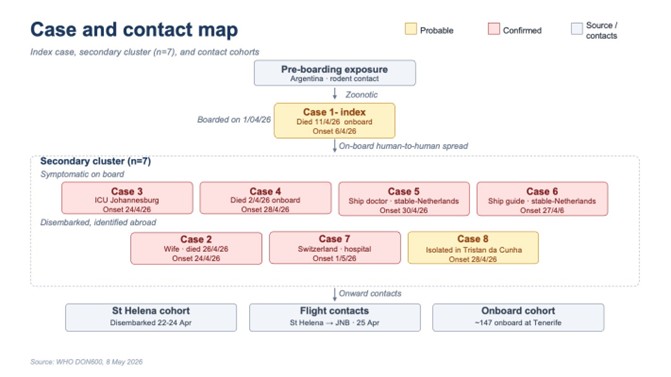
Figure 2: Early cases and contact map of passengers onboard MV-Hondius as on 8/05/2026
Shipboard diagnostic capacity is calibrated for common pathogens for which commercial tests are available. Most cruise medical centres can perform rapid antigen tests for influenza, SARS-CoV-2, and norovirus, but lack capability for rarer, high-consequence pathogens such as hantavirus, Lassa Fever, Ebola, Marburg, or other haemorrhagic fevers. A risk-stratified syndromic surveillance approach, in which clusters of severe febrile respiratory illness without alternative aetiology trigger immediate isolation of cases, quarantine of contacts and evacuation rather than awaiting laboratory confirmation, should be considered. This can be enhanced by situational awareness of epidemic activity in the region of the cruise using global open-source epidemic intelligence – in this case hantavirus may have been considered if medical staff were aware of rising recent incidence of the disease in Argentina. The three crew including a ships doctor with acute respiratory symptoms illustrate the occupational risk to crew. Diagnostic delay directly delays case ascertainment and risk stratification, with crew historically under-investigated despite their role as persistent transmission bridges30,31.
Second, the IHR 2005 Maritime Declaration of Health is insufficiently sensitive to severe sporadic events. The current attack-rate thresholds may miss low-incidence, high-mortality clusters. In this case, the death of the index case was assumed to be from a non-infectious cause. Recent work from Hungary by Koroknai and colleagues demonstrates that even in well-resourced terrestrial surveillance systems, hantavirus diagnosis is delayed by reliance on serology, with viral RNA detectable in whole blood when paired serum is negative21. This has direct implications for shipboard specimen collection protocols, where EDTA whole blood is rarely retained for molecular testing.
Third, formal outbreak investigation and response, including post-disembarkation contact tracing is structurally fragmented. The South African National Institute for Communicable Diseases is currently tracing contacts in the Johannesburg region32, but the Hondius manifest spans multiple nationalities from 23 countries, with passengers dispersing across European and North American jurisdictions and South Atlantic islands. The IHR provides for inter-state communication via National IHR Focal Points, but no standing mechanism exists for harmonised post-cruise surveillance of cohorts exposed to a novel or rare pathogen- a gap that the Diamond Princess experience identified but did not resolve17. The Hondius situation illustrates this fragmentation in real time: as of 4 May 2026, Cape Verdean authorities had not yet authorised the medical transfer of the two ill persons still on board, and the operator was preparing alternative gateways at Las Palmas or Tenerife for screening and disembarkation. Further, the United States has left the WHO, who are coordinating the international response. There were seven Americans who disembarked at St Helena, and 17 Americans repatriated from Tenerife by the US government. On 8 May 2026, WHO issued two interim guidance documents specifically for the Hondius event- one establishing operational case definitions, risk-stratified contact classification, and a 42-day active monitoring framework, and a companion technical note on disembarkation and onward management of passengers and crew33,34. While these provide a welcome operational scaffold, they are specific for this outbreak, highlighting the absence of a standing pre-agreed multinational protocol for cohorts exposed to rare, high-consequence pathogens on maritime vessels.
Fourth, genomic characterisation is not embedded in the routine maritime outbreak response toolkit. Hantaviruses are reservoir-specific, with Andes virus the only species in which sustained person-to-person transmission has been documented, and that for Clade 2; species identification therefore directly determines whether human-to-human transmission is possible, the scope of contact tracing, and the management of potential cases and contacts during and after repatriation. While awaiting diagnostic results, the precautionary principle should have been used to protect contacts, including health workers. Genomic epidemiology played a role in reconstructing Diamond Princess transmission chains and will assist in understanding this outbreak. The window for these analyses is narrow: viral load falls rapidly with seroconversion, and post-mortem tissue degrades26. Sequencing capacity exists at NICD South Africa, KRISP, and European reference laboratories, but IHR 2005 does not currently mandate genomic characterisation of unusual maritime events, or specimen retention, with no standardised cross-jurisdictional shipping protocols. In this case phylogenetic analysis of the Swiss case was released on 8th May35.
Immediate priorities include WHO in coordination with the IMO, reviewing the Maritime Declaration of Health reporting criteria. They could consider including clusters of two or more cases of severe acute respiratory illness, haemorrhagic illness, or unexplained deaths, irrespective of predefined reporting thresholds, accompanied by enforceable on-board outbreak protocols covering contact tracing, quarantine of contacts, and crew occupational health and safety. Cruise ships should also have PPE stockpiles and protocols that include N95 respirators. Cruise ship companies should have global, open-source epidemic surveillance available at all times, including pre-voyage, to improve situational awareness of serious emerging infections and outbreaks36. Diagnostic protocols should include antigenic and genomic characterisation of any unexplained febrile illness, and rapid transport of specimens to reference laboratories. Cruise operators should retain EDTA whole-blood specimens from all clinically evaluated passengers for ≥30 days post-voyage to enable retrospective confirmation. Emergency departments in hospitals around the world should have access to global surveillance data so febrile patients with a travel history can be isolated rapidly if they have come from a country experiencing a high-consequence pathogen outbreak, rather than waiting hours for a diagnosis and potentially causing a nosocomial outbreak. Such data feeds can be integrated with hospital triage software to improve awareness and reduce nosocomial outbreaks. The Hungary cohort data21 can inform the WHO hantavirus diagnostic guidelines to specify parallel serum and whole-blood molecular testing as first-line, displacing serology as the sole acute-phase modality. Global data sharing and globally consistent protocols for managing potential high-consequence outbreaks are important, with the precautionary principle guiding management of high-fatality outbreaks whilst awaiting diagnostic results. This would include isolating cases, quarantining contacts and providing respirators for healthcare staff and other close contacts. Multi-country contact tracing for travel-associated outbreaks is strengthened by functioning IHR National Focal Point channels. The United States' departure from the WHO with 24 US nationals aboard the Hondius exposes a structural gap that warrants bilateral and regional fallback arrangements (e.g., CDC-ECDC and PAHO-national ministry compacts) to enable timely manifest sharing, exposure assessment, and onward monitoring. All countries should have surveillance systems, contact tracing and monitoring mechanisms for travel-related outbreaks.
The Hondius outbreak is a sentinel event. It has already caused a multi-country epidemic, with confirmed and probable cases in South Africa, Switzerland, Tristan de Cunha, France and the United States. This challenges the post-COVID-19 assumption that capacity built for the next respiratory pandemic equips systems for high-consequence pathogen outbreaks. Unexpected, high-consequence maritime outbreaks are a real and evolving threat, demanding stronger surveillance, coordinated international response systems, and preparedness frameworks capable of addressing a far broader spectrum of emerging infectious diseases.
1. WHO. Three dead in suspected hantavirus infection outbreak on cruise ship: WHO | UN News. May 3, 2026. Accessed May 4, 2026. https://news.un.org/en/story/2026/05/1167431
2. WHO. WHO Director-General’s opening remarks at the media briefing. May 7, 2026. Accessed May 8, 2026. https://www.who.int/news-room/speeches/item/who-director-general-s-opening-remarks-at-the-media-briefing---7-may-2026
3. WHO. Hantavirus cluster linked to cruise ship travel, Multi-country. May 4, 2026. Accessed May 6, 2026. https://www.who.int/emergencies/disease-outbreak-news/item/2026-DON599
4. Neumann JA, Zimmermann J, Frese M, et al. Infectious diseases on passenger ships: Port preparedness and response - A narrative systematic review. Travel Medicine and Infectious Disease. 2025;67:102886. doi:https://doi.org/10.1016/j.tmaid.2025.102886
5. MacIntyre CR, Lim S, Quigley A. Preventing the next pandemic: Use of artificial intelligence for epidemic monitoring and alerts. Cell Rep Med. 2022;3(12). doi:https://doi.org/10.1016/j.xcrm.2022.100867
6. Martínez VP, Paola ND, Alonso DO, et al. “Super-Spreaders” and Person-to-Person Transmission of Andes Virus in Argentina. New England Journal of Medicine. 2020;383(23):2230-2241. doi:https://doi.org/10.1056/NEJMoa2009040
7. Mouchtouri VA, Nichols G, Rachiotis G, et al. State of the art: public health and passenger ships. Int Marit Health. 2010;61(2):49-98.
8. Mouchtouri VA, Lewis HC, Hadjichristodoulou C, EU SHIPSAN ACT Joint Action Partnership. A Systematic Review for Vaccine-Preventable Diseases on Ships: Evidence for Cross-Border Transmission and for Pre-Employment Immunization Need. Int J Environ Res Public Health. 2019;16(15):2713. doi:https://doi.org/10.3390/ijerph16152713
9. Crisp CA, Jenkins KA, Dunn I, et al. Notes from the Field: Cruise Ship Norovirus Outbreak Associated with Person-to-Person Transmission — United States Jurisdiction, January 2023. MMWR Morb Mortal Wkly Rep. 2023;72(30):833-834. doi:https://doi.org/10.15585/mmwr.mm7230a5
10. WHO. International Health Regulations (2005) – Third edition. January 1, 2016. Accessed March 27, 2026. https://www.who.int/publications/i/item/9789241580496
11. Mouchtouri VA, Verykouki E, Zamfir D, Hadjipetris C, Lewis HC, Hadjichristodoulou C. Gastroenteritis outbreaks on cruise ships: contributing factors and thresholds for early outbreak detection. Euro Surveill. 2017;22(45):16-00576. doi:https://doi.org/10.2807/1560-7917.ES.2017.22.45.16-00576
12. Quigley AL, Nguyen PY, Stone H, Lim S, MacIntyre CR. Cruise Ship Travel and the Spread of COVID-19 – Australia as a Case Study. International Journal of Travel Medicine and Global Health. 2021;9(1):10-18. doi:https://doi.org/10.34172/ijtmgh.2021.03
13. Mizumoto K, Kagaya K, Zarebski A, Chowell G. Estimating the asymptomatic proportion of coronavirus disease 2019 (COVID-19) cases on board the Diamond Princess cruise ship, Yokohama, Japan, 2020. Euro Surveill. 2020;25(10):2000180. doi:https://doi.org/10.2807/1560-7917.ES.2020.25.10.2000180
14. Tokuda Y, Sakihama T, Aoki M, et al. COVID-19 outbreak on the Diamond Princess Cruise Ship in February 2020. J Gen Fam Med. 2020;21(4):95-97. doi:https://doi.org/10.1002/jgf2.326
15. Azimi P, Keshavarz Z, Cedeno Laurent JG, Stephens B, Allen JG. Mechanistic transmission modeling of COVID-19 on the Diamond Princess cruise ship demonstrates the importance of aerosol transmission. Proc Natl Acad Sci U S A. 2021;118(8):e2015482118. doi:https://doi.org/10.1073/pnas.2015482118
16. Oran DP, Topol EJ. Prevalence of Asymptomatic SARS-CoV-2 Infection : A Narrative Review. Ann Intern Med. 2020;173(5):362-367. doi:https://doi.org/10.7326/M20-3012
17. Medley AM, Marston BJ, Toda M, et al. Use of US Public Health Travel Restrictions during COVID-19 Outbreak on Diamond Princess Ship, Japan, February-April 2020. Emerg Infect Dis. 2021;27(3):710-718. doi:https://doi.org/10.3201/eid2703.203820
18. Maes P, Tischler N. Statement from the International Hantavirus Society and members of the international hantavirus research and clinical community regarding Andes virus transmission and the current outbreak investigation. doi:https://doi.org/10.5281/zenodo.20075274
19. CDC. Guidance for Cruise Ships on Management of Acute Respiratory Illness (ARI) due to Viral Infection. Port Health. May 15, 2025. Accessed May 7, 2026. https://www.cdc.gov/port-health/php/maritime-guidance/guidance-for-cruise-ships-on-management-of-acute-respiratory-illness-ari-due-to-viral-infection.html
20. ECDC. COVID-19: EU guidance for cruise ship operations. May 12, 2021. Accessed May 7, 2026. https://www.ecdc.europa.eu/en/publications-data/COVID-19-cruise-ship-guidance
21. Koroknai A, Nagy A, Nagy O, et al. Human Hantavirus Infections in Hungary (2018-2025): Epidemiology, Molecular Detection Across Clinical Sample Types, and Phylogenetic Analysis. Viruses. 2026;18(3):366. doi:https://doi.org/10.3390/v18030366
22. Jonsson CB, Figueiredo LTM, Vapalahti O. A global perspective on hantavirus ecology, epidemiology, and disease. Clin Microbiol Rev. 2010;23(2):412-441. doi:https://doi.org/10.1128/CMR.00062-09
23. Quigley AL, Kunasekaran M, Stone H, et al. The impact of the cruise ship Coral Princess on COVID-19 transmission in regional Western Australia in 2022. J Travel Med. 2025;32(2):taae044. doi:https://doi.org/10.1093/jtm/taae044
24. Mathews JD, McCaw CT, McVernon J, McBryde ES, McCaw JM. A Biological Model for Influenza Transmission: Pandemic Planning Implications of Asymptomatic Infection and Immunity. PLOS ONE. 2007;2(11):e1220. doi:https://doi.org/10.1371/journal.pone.0001220
25. Afzal S, Ali L, Batool A, et al. Hantavirus: an overview and advancements in therapeutic approaches for infection. Front Microbiol. 2023;14:1233433. doi:https://doi.org/10.3389/fmicb.2023.1233433
26. Ferrés M, Martínez-Valdebenito C, Henriquez C, et al. Viral shedding and viraemia of Andes virus during acute hantavirus infection: a prospective study. The Lancet Infectious Diseases. 2024;24(7):775-782. doi:https://doi.org/10.1016/S1473-3099(24)00142-7
27. Park K, Kim CS, Moon KT. Protective Effectiveness of Hantavirus Vaccine. Emerg Infect Dis. 2004;10(12):2218-2220. doi:https://doi.org/10.3201/eid1012.040684
28. Yi Y, Park H, Jung J. Effectiveness of inactivated hantavirus vaccine on the disease severity of hemorrhagic fever with renal syndrome. Kidney Res Clin Pract. 2018;37(4):366-372. doi:https://doi.org/10.23876/j.krcp.18.0044
29. Wells RM, Sosa Estani S, Yadon ZE, et al. An unusual hantavirus outbreak in southern Argentina: person-to-person transmission? Hantavirus Pulmonary Syndrome Study Group for Patagonia. Emerg Infect Dis. 1997;3(2):171-174. doi:https://doi.org/10.3201/eid0302.970210
30. Rachiotis G, Mouchtouri VA, Schlaich C, et al. Occupational health legislation and practices related to seafarers on passenger ships focused on communicable diseases: results from a European cross-sectional study (EU SHIPSAN PROJECT). J Occup Med Toxicol. 2010;5(1):1. doi:https://doi.org/10.1186/1745-6673-5-1
31. Siame S, Bygvraa DA, Hulse LM, Mouchtouri V, Hadjichristodoulou C. Factors influencing the occurrence of infectious diseases among crew members on board cruise ships: a systematic review. Int Marit Health. 2025;76(1):63-70. doi:https://doi.org/10.5603/imh.98558
32. Edwards M. Three passengers dead after suspected hantavirus outbreak on cruise ship. The Guardian. May 3, 2026. Accessed May 4, 2026. https://www.theguardian.com/world/2026/may/03/three-passengers-dead-after-suspected-hantavirus-outbreak-on-cruise-ship
33. WHO. World Health Organization. Technical note for the disembarkation and onward management of passengers and crew in the context of an Andes virus-associated cluster- MV Hondius cruise ship: Interim guidance. Published online May 8, 2026. https://www.who.int/publications/m/item/who-technical-note-for-the-disembarkation-and-onward-management-of-passengers-and-crew-in-the-context-of-an-andes-virus-associated-cluster-mv-hondius-cruise-ship
34. WHO. World Health Organization. Management of contacts of Andes virus (ANDV) cases from the MV Hondius cruise ship: Interim guidance. Published online May 8, 2026. https://www.who.int/publications/m/item/management-of-contacts-of-andes-virus-(andv)-cases-fromthe-mv-hondius-cruise-ship
35. Bloemberg Guido, Chudzinski Valentin, Cordey Samuel, et al. Complete sequence of Orthohantavirus andesense virus: Swiss resident 2026 - Hantavirus. Virological. May 8, 2026. Accessed May 11, 2026. https://virological.org/t/complete-sequence-of-orthohantavirus-andesense-virus-swiss-resident-2026/1023
36. MacIntyre CR, Chen X, Kunasekaran M, et al. Artificial intelligence in public health: the potential of epidemic early warning systems. J Int Med Res. 2023;51(3):03000605231159335. doi:https://doi.org/10.1177/03000605231159335