This article examines the limits of framing national biosecurity primarily as the responsibility of ministries of health. While health authorities remain central to surveillance, clinical response, vaccination, and public communication, contemporary biological threats frequently exceed the capacity of any single sector. Pandemics, supply chain disruptions, mobility crises, data coordination failures, and cascading pressures on essential services require broader state capabilities extending across transport, finance, logistics, digital systems, and territorial administration. The article investigates what strategic management lessons for national biosecurity can be drawn from Indonesia’s experience as a large, decentralised archipelagic state. The study uses a qualitative secondary data analysis based on official reports, regulations, institutional documents, international governance sources, and recent academic literature. Findings suggest that health ministries alone are insufficient during complex biological emergencies. Effective preparedness depends on pre-existing interagency coordination mechanisms, clear authority structures, scalable logistics systems, interoperable information platforms, and adaptive leadership able to align fragmented institutions under uncertainty. Indonesia demonstrates that distributed state capability, rather than sectoral expertise alone, strongly influences resilience and implementation performance. The study identifies recurring governance constraints, including overlapping mandates, variation in subnational implementation capacity, and delayed interagency coordination, particularly across geographically dispersed and administratively diverse jurisdictions.
COVID-19 demonstrated with unusual clarity that biological threats are not confined to the health sector. Pandemics disrupted labour markets, transport systems, education, fiscal stability, and international mobility, while exposing vulnerabilities in social trust and state coordination. At the same time, the wider biosecurity landscape now includes zoonotic spillovers linked to environmental change, antimicrobial resistance, laboratory accidents, and the misuse of synthetic biology tools (1-3). Findings from recent scholarship suggest that effective preparedness depends not only on hospitals or surveillance systems, but also on resilient supply chains, interoperable institutions, and the capacity to sustain essential services during prolonged disruption (4,5). National biosecurity, therefore, increasingly concerns societal resilience as much as public health management.
Despite these lessons, many countries continue to assign primary responsibility for biological risk to ministries of health. Such arrangements remain necessary, yet they are rarely sufficient when crises generate cascading effects across multiple sectors. Border management requires transport and immigration authorities; emergency procurement depends on finance ministries; data tracing and communication rely on digital systems; distribution of medicines and food requires logistics networks; and local implementation depends on subnational government capacity. Where these functions are fragmented, response speed may decline and accountability may become unclear. Comparative studies of crisis governance indicate that whole-of-government coordination often remains weaker in practice than in formal plans (6,7). Fragmented authority reduced response speed in numerous jurisdictions during COVID-19.
This article argues that biosecurity should also be understood as a strategic management challenge. Biological crises are characterised by uncertainty, evolving information, time pressure, and interdependence among agencies. Under such conditions, effective preparedness requires strategic leadership able to define priorities, align institutions, and revise plans as evidence changes. Scenario planning can widen anticipation of low-probability but high-impact risks (8). Dynamic capabilities such as sensing, seizing, and reconfiguring resources help governments adapt rapidly (9). Sensemaking remains critical when signals are ambiguous (10), while crisis management scholarship highlights the importance of coordination, legitimacy, and learning under stress (11). National biosecurity requires coordinated institutional capacity rather than sectoral expertise alone.
Indonesia provides a valuable case through which to examine these dynamics. As the world’s largest archipelagic state, Indonesia must govern biological risk across dispersed islands, varied infrastructure conditions, and complex mobility corridors. Decentralised governance gives provinces and districts significant implementation roles, yet capacities remain uneven. At the same time, Indonesia possesses substantial state assets beyond the health ministry, including disaster management institutions, military logistics capability, and national planning mechanisms. Its Indo-Pacific location, dense maritime connectivity, and large population further heighten the relevance of preparedness. Indonesia should therefore be viewed not as an exceptional outlier, but as a source of lessons for other geographically diverse and administratively complex states (12-14).
Much existing literature focuses on epidemiology, medical treatment, vaccine policy, and health administration. These contributions are indispensable. However, more limited scholarship conceptualises national biosecurity as a strategic management problem involving multiple state institutions, competing mandates, and cross-sector resource mobilisation. The governance question of how states organise themselves for biological disruption remains comparatively underdeveloped.
In order to fill this gap, the research utilizes a qualitative secondary data analysis of various policy documents, government reports, international governance evaluations, institutional publications, and peer-reviewed studies related to biosecurity governance, crisis management, and comprehensive governmental readiness. Indonesia serves as the primary case study due to its decentralized governance framework, archipelagic geography, and intricate administrative structures, which offer a significant context for exploring the management of biological emergencies across diverse institutions and governmental tiers. By conducting a thematic analysis of around 60 authoritative sources, the research uncovers persistent governance trends, coordination difficulties, and strategic management insights pertinent to national biosecurity preparedness.
Building upon this analytical approach, the article examines how Indonesia’s experience demonstrates the need to move beyond health-ministry-centred models toward integrated strategic management for national biosecurity. It addresses three questions: (1) Why are health ministries insufficient alone? (2) What strategic management lessons emerge from Indonesia? (3) How can governments build integrated national biosecurity systems?
This study adopts a qualitative research design using secondary data analysis to examine how national biosecurity can be strengthened through integrated governance and strategic management. A qualitative approach is appropriate because the article focuses on institutional coordination, preparedness systems, authority arrangements, and state responses to biological crises rather than testing a single causal relationship. The analysis is interpretive and policy-oriented, seeking to understand how governments organise capabilities across sectors under conditions of uncertainty. Indonesia is employed as the principal case, while comparative insights from broader international experience are incorporated where relevant to identify lessons applicable to other states (15).
The study draws upon a systematic qualitative secondary data analysis of approximately 60 documents published primarily between 2016 and 2026. To improve analytical transparency, document selection followed a structured screening procedure adapted from qualitative evidence synthesis approaches commonly used in policy and governance research. Sources were identified through targeted searches of international organisation repositories, government databases, academic journal databases, and institutional publication platforms.
Searches employed combinations of keywords including biosecurity governance, pandemic preparedness, whole-of-government coordination, health security, crisis management, Indonesia COVID-19 response, emergency governance, institutional resilience, and strategic management. Additional documents were identified through reference chaining from highly cited publications and official policy reports.
Inclusion criteria consisted of: (1) documents directly addressing biosecurity, pandemic preparedness, crisis governance, emergency management, or strategic coordination; (2) publications produced by recognised international organisations, government institutions, or peer-reviewed academic journals; (3) sources containing substantive discussion of governance arrangements, institutional coordination, resource mobilisation, information systems, or adaptive policy responses; and (4) materials published between 2016 and 2026, except for a limited number of seminal theoretical references retained for conceptual grounding.
Exclusion criteria included documents lacking direct relevance to governance and preparedness systems, purely clinical or epidemiological studies without institutional implications, duplicate publications, opinion pieces without empirical or policy foundations, and sources with insufficient methodological or institutional credibility.
The screening process initially identified approximately 120 potentially relevant documents. Following title, abstract, executive summary, and content review, 60 sources were retained for detailed analysis. The final dataset comprised World Health Organization preparedness assessments and International Health Regulations monitoring reports, World Bank governance and resilience publications, OECD reports, Indonesian presidential regulations and emergency directives, BNPB coordination documents, Ministry of Health publications, Bappenas planning documents, United Nations reports, and peer-reviewed academic literature on governance, crisis management, decentralisation, and strategic management.
The selected documents were analysed using reflexive thematic analysis combined with comparative policy interpretation. The analytical framework was organised around five predefined dimensions derived from the research questions and governance literature: (1) authority structure, (2) coordination mechanisms, (3) resource mobilisation, (4) information systems, and (5) adaptive learning.
Analysis proceeded through several iterative stages. First, documents were read repeatedly to identify recurring institutional patterns, governance challenges, operational bottlenecks, and strategic management practices associated with biological emergencies. Second, relevant text segments were coded according to the five analytical dimensions. Third, codes were grouped into broader thematic categories reflecting common governance dynamics across the dataset. Finally, themes were compared across different document types and institutional sources to identify convergent patterns, explanatory relationships, and transferable governance lessons.
To enhance analytical reliability, findings were triangulated across multiple categories of evidence, including international assessments, national policy documents, institutional reports, and peer-reviewed scholarship. Emerging interpretations were continuously compared against alternative explanations and verified across multiple sources before inclusion in the final thematic framework. This process reduced dependence on any single document and strengthened the credibility of the resulting interpretations.
This method is suitable for examining complex governance systems where institutional interactions, coordination processes, and strategic decision-making are more important than statistical measurement. Secondary data analysis enables comprehensive examination of biosecurity governance across multiple organisations and administrative levels while facilitating triangulation among diverse sources of evidence. Rather than seeking statistical generalisation, the study aims to generate analytical explanations and transferable policy insights concerning the governance capacities required for effective national biosecurity preparedness.
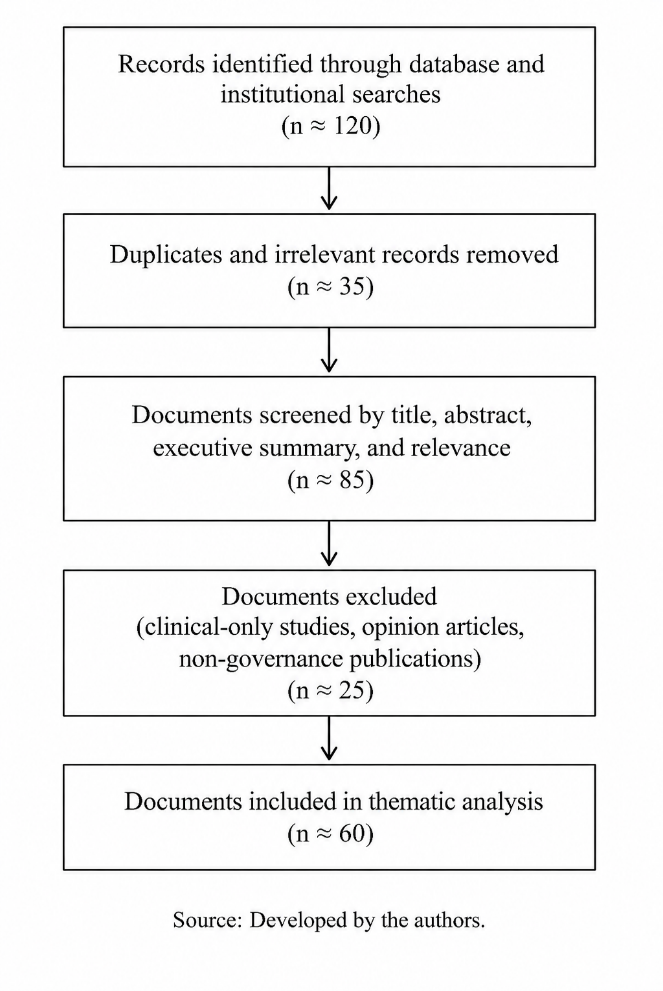
The document selection process was conducted systematically to enhance the transparency and credibility of the secondary data analysis. Following established principles of qualitative evidence synthesis, documents were identified, screened, and evaluated according to predefined inclusion and exclusion criteria. The process involved multiple stages of document identification, relevance assessment, and eligibility review to ensure that only sources directly relevant to biosecurity governance, preparedness, crisis management, and strategic coordination were included in the final dataset. Figure 1 summarises the document selection and screening procedure employed in this study.
Figure 1. Document Selection and Screening Process
Source: Developed by the authors.
As illustrated in Figure 1, the screening procedure began with approximately 120 documents identified through database searches, institutional repositories, policy archives, and reference chaining. Following the removal of duplicate and irrelevant records, 85 documents underwent detailed screening based on titles, abstracts, executive summaries, and substantive relevance to the research objectives. Documents focusing exclusively on clinical or epidemiological issues without governance implications, opinion-based publications, and sources lacking sufficient institutional relevance were excluded. The final dataset consisted of approximately 60 documents that met all inclusion criteria and provided the evidential foundation for the thematic analysis. This structured screening process strengthened analytical transparency and reduced the risk of selective source inclusion.
Findings indicate that biological emergencies rapidly exceed the operational boundaries of health ministries. While epidemiological surveillance, clinical guidance, and vaccination policy remained central functions, crisis management also depended on systems normally located outside the health sector. During COVID-19, disruptions to global and domestic supply chains affected access to medicines, oxygen, personal protective equipment, and laboratory materials. Border management pressures required coordination among immigration, customs, transport, and maritime authorities. Mobility restrictions and quarantine measures further demanded policing capacity, public communication systems, and legal enforcement mechanisms (16,17).
The evidence suggests that labour continuity and essential services became equally significant dimensions of biosecurity. Food distribution, utilities, financial transfers, and emergency transport all required rapid cross-sector adjustment. Vaccine deployment similarly depended on cold-chain logistics, warehousing, route planning, and local administrative execution rather than health expertise alone (18). In many settings, digital tracing platforms and population databases were also essential for case monitoring and targeted support. These findings support a consistent conclusion: health expertise is necessary but insufficient when crises generate whole-of-society disruption. Effective preparedness depended on institutional coordination extending beyond ministries of health.
Indonesia demonstrates how biological crisis response can evolve into a whole-of-government effort. Although the Ministry of Health retained primary responsibility for surveillance, treatment guidance, and vaccination policy, implementation relied on a broader state network. BNPB played an important coordinating role in emergency management and logistics, while the Armed Forces (TNI) supported transportation, field facilities, and distribution operations. Police institutions contributed to mobility management and public order functions. Provincial and district governments were central to local enforcement, service adaptation, and community outreach (19-21).
State-owned enterprises and private logistics providers also contributed to procurement, warehousing, and delivery systems. Digital agencies and technology partners supported registration platforms, mobility monitoring, and communication tools. The cumulative pattern suggests that Indonesia’s response was not merely an exercise in sectoral health administration, but a form of de facto strategic management in which multiple institutions were assembled around changing operational priorities. National readiness emerged through distributed state capacity rather than through any single ministry. This has broader relevance for decentralised middle-income states where implementation authority, infrastructure quality, and administrative capability are unevenly distributed across territory.
At the same time, the evidence suggests that fragmented authority reduced response speed in several phases of crisis management. Overlapping mandates among central agencies created uncertainty regarding leadership functions, especially during transitions between emergency and routine governance arrangements. In decentralised settings, centre-local tension also affected the timing and consistency of restrictions, reporting, and enforcement measures. Different localities often faced varying incentives and resource constraints, which complicated policy uniformity (22,23).
Evidence from Indonesia further illustrates how uneven administrative capacity across provinces and districts influenced the implementation of national response measures (24,25). During the COVID-19 pandemic, substantial variation emerged in testing capacity, contact tracing performance, healthcare infrastructure, and vaccination deployment across regions (25,26). Provinces with stronger administrative resources and better-developed health systems generally demonstrated faster implementation and reporting performance, whereas more remote and resource-constrained areas experienced operational delays and logistical challenges (24,26). Studies of Indonesia’s pandemic response also highlight tensions between national directives and local implementation priorities, particularly during the early stages of mobility restrictions and public health interventions (22,25). Variations in local fiscal capacity, institutional preparedness, and intergovernmental coordination contributed to differences in policy execution across jurisdictions (22,23). These experiences suggest that formal policy consistency at the national level does not necessarily guarantee uniform implementation outcomes at the subnational level.
Inconsistent reporting systems further constrained situational awareness. Where data standards, testing records, or hospital dashboards were not fully integrated, decision-makers faced delays in identifying pressure points and reallocating resources. Procurement bottlenecks were also observed in many countries, including delays associated with regulatory approval, contracting processes, and market scarcity. Shifting regulations and communication gaps sometimes reduced compliance or created uncertainty among businesses and local administrators. Uneven subnational execution was evident in the differing capacities of provincial and district governments to operationalise national directives (24,25). While some jurisdictions rapidly adapted surveillance systems, vaccination programmes, and mobility controls, others faced constraints associated with limited personnel, weaker infrastructure, logistical bottlenecks, and fragmented reporting mechanisms (24,26). As a result, identical national policies often generated different implementation outcomes across regions (22,25). The Indonesian experience demonstrates that governance effectiveness during biological emergencies depends not only on policy design at the centre but also on the administrative capability and coordination capacity of subnational institutions responsible for frontline implementation (24,26).
The principal lesson is institutional rather than political: without pre-designed coordination architecture, crisis response slows and becomes more costly in time, resources, and public confidence.
Findings indicate that some of the most consequential capabilities during biological emergencies were located outside ministries of health. Military logistics capacity supported rapid movement of personnel, medical supplies, and temporary infrastructure across dispersed geographies. In an archipelagic state, airlift, maritime transport, and territorial command networks were particularly relevant to last-mile delivery. Finance ministries determined the speed and flexibility of emergency budgeting, compensation measures, and procurement financing. Transport ministries influenced mobility controls, freight continuity, and port operations. Telecommunications infrastructure enabled remote work, digital consultation, public messaging, and data transmission (27,28).
Digital identity systems and interoperable registries were also strategically significant for vaccination scheduling, benefit targeting, and population verification. Procurement agencies and state warehousing systems shaped the availability of critical goods during periods of scarcity. Local territorial administration networks often became the interface through which national directives were translated into household-level implementation. These functions are not secondary to biosecurity; they are core enabling capacities.
The evidence therefore suggests that biosecurity capacity is distributed across the state rather than concentrated in one sector. Preparedness depends on the strategic integration of dispersed capabilities before emergencies occur, including clear authority triggers, interoperable data systems, reserve logistics, and practiced coordination routines. Indonesia demonstrates how non-health institutions can substantially determine operational success during biological emergencies, particularly where geography and decentralisation complicate implementation.
Taken together, the findings suggest that national biosecurity readiness depends less on sectoral expertise alone than on the state’s ability to coordinate distributed capabilities under conditions of uncertainty.
This article argues that biosecurity should be conceptualised as a national strategic management challenge rather than solely a matter of health-service administration. The findings suggest that biological emergencies create simultaneous pressures involving coordination, logistics, authority, information management, continuity of essential services, and adaptive governance. These pressures frequently emerge at greater speed than conventional sectoral institutions are designed to manage. Ministries of health remain indispensable for surveillance, clinical standards, laboratory systems, and public communication on disease risk. However, ministry-centred models may be insufficient when disruption becomes cross-sectoral and affects transport, trade, education, fiscal stability, and territorial administration. The findings suggest that biological crises test the management capacity of the state as much as the clinical capacity of health systems (29). A broader governance perspective is therefore required, one that treats preparedness as an issue of institutional integration across the public sector.
To clarify the distinction identified in the findings, Table 1 contrasts a conventional sectoral health-ministry model with a broader strategic management model of national biosecurity. The comparison demonstrates that while ministry-centred arrangements retain important technical value, large-scale biological emergencies require integrated authority, cross-sector coordination, and distributed state capability.
Table 1.Sectoral vs Strategic Management Models of Biosecurity
| Dimension | Sectoral Health-Ministry Model | Strategic Management Model |
| Core Assumption | Biosecurity is primarily a public health issue | Biosecurity is a whole-of-government national risk issue |
| Lead Institution | Ministry of Health dominates planning and response | Central coordinating authority with health ministry as key partner |
| Decision Logic | Clinical and epidemiological priorities | Multi-sector prioritisation balancing health, logistics, economy, and continuity |
| Authority Structure | Vertical, ministry-centred hierarchy | Unified command with predefined escalation and shared mandates |
| Coordination Mechanism | Ad hoc interministerial consultation during crisis | Permanent cross-government coordination mechanisms before crisis |
| Information Systems | Health surveillance databases | Integrated real-time data across ministries and subnational authorities |
| Resource Mobilisation | Health budgets, hospitals, laboratories | National mobilisation of finance, transport, defence, SOEs, digital assets |
| Logistics Capacity | Medical supply chains and vaccine delivery | Strategic stockpiles, warehousing, national transport, surge distribution |
| Subnational Governance | Local health offices as primary implementers | Whole local government participation with territorial coordination |
| Adaptability | Reactive adjustments during emergencies | Scenario planning, simulation exercises, adaptive learning systems |
| Main Strength | Strong technical disease response capability | Strong system-wide resilience and coordinated crisis execution |
| Main Limitation | Can be overwhelmed by cross-sector disruption | Requires sustained political commitment and institutional discipline |
| Best Use Context | Contained outbreaks with limited spillover effects | Large-scale biological crises with cascading societal impacts |
Source: Developed by the authors based on findings from the manuscript.
As shown in Table 1, the principal difference lies not in the importance of health expertise, but in the scope of institutional mobilisation. The strategic management model incorporates health leadership within a wider state architecture capable of managing cascading disruption, resource integration, and adaptive response.
The five strategic pillars proposed in this study emerged directly from the thematic findings presented in the Results section. Rather than representing a normative framework developed independently from the evidence, the pillars constitute a synthesis of recurring governance patterns identified across the analysed documents. Theme 1 highlighted the limitations of ministry-centred approaches during biological emergencies, demonstrating the need for clear authority structures capable of coordinating multiple sectors. Theme 2 emphasised the importance of whole-of-government mobilisation and institutional collaboration, which informed the pillar of interagency coordination. Theme 3 revealed how fragmented authority, inconsistent reporting systems, and uneven implementation capacity constrained response effectiveness, underscoring the importance of integrated information systems and institutional learning. Theme 4 showed that critical response capabilities frequently reside outside ministries of health, particularly within logistics, finance, transport, security, and digital institutions, thereby supporting the pillar of strategic logistics and distributed resource mobilisation. Taken together, these findings indicate that national biosecurity preparedness depends on the alignment of authority, coordination, logistics, information, and learning capacities across the broader governance system.
To clarify the analytical relationship between the empirical findings and the proposed framework, Table 2 maps each thematic finding to the strategic pillar derived from it. This mapping demonstrates that the framework is grounded in the evidence generated through the thematic analysis rather than being imposed a priori.
Table 2. Relationship Between Thematic Findings and Strategic Pillars
| Thematic Findings | Strategic Pillar Generated |
| Theme 1: Health Ministries Cannot Govern Biosecurity Alone | Unified Authority |
| Theme 2: Indonesia Demonstrated Whole-of-Government Necessity | Interagency Coordination |
| Theme 3: Coordination Fragmentation Reduced Response Speed | Integrated Information Systems; Institutional Learning |
| Theme 4: Strategic Assets Outside the Health Sector Matter | Strategic Logistics |
| Cross-cutting Findings Across All Themes | Institutional Learning and Adaptive Governance |
Source: Developed by the authors based on thematic analysis.
As shown in Table 2, each strategic pillar reflects a recurring governance challenge or capability identified in the findings. The framework therefore represents an evidence-based synthesis of the institutional lessons emerging from Indonesia’s biosecurity experience. Rather than proposing entirely new governance principles, the framework consolidates observed patterns of authority, coordination, logistics, information management, and adaptive learning into a practical structure for strengthening national biosecurity preparedness.
Building upon the thematic findings and the relationships summarised in Table 2, the study proposes a practical framework for national biosecurity organised around five interrelated strategic pillars.
1. Unified Authority. Effective preparedness depends on clear emergency command structures with defined escalation rules, legal triggers, and lines of accountability. Ambiguous authority can delay decisions and fragment operational control (30).
2. Interagency Coordination. Permanent cross-government coordination mechanisms should be established before crises emerge. Standing committees, joint planning cells, and interoperable standard operating procedures can reduce transaction costs during emergencies. Coordination is most effective when practiced routinely rather than improvised under pressure (31).
3. Strategic Logistics. Biological emergencies require stockpiles, mobility assets, procurement agility, surge warehousing, and scalable distribution systems. Supply resilience is especially important where geography complicates last-mile delivery or import dependence creates vulnerability (32).
4. Integrated Information Systems. Real-time data sharing across ministries and subnational authorities improves situational awareness, resource targeting, and public communication. Fragmented databases or incompatible reporting systems can weaken response quality. Interoperability should therefore be treated as a strategic asset rather than a technical afterthought (33).
5. Institutional Learning. After-action review systems, simulation exercises, red-team testing, and regular policy revision help states adapt to emerging threats. Preparedness is dynamic rather than static; institutions that learn systematically are better positioned for future shocks (34).
Taken together, these five pillars support resilience in both preparedness and response phases by aligning authority, capability, and learning capacity.
The thematic findings demonstrate that authority, logistics, information management, and operational implementation are distributed across multiple organisations. Consequently, a conventional hierarchical representation would not adequately capture the collaborative and interdependent nature of contemporary biosecurity governance. The framework presented below therefore adopts a network perspective that emphasises coordination, interoperability, and shared responsibility across institutions. Figure 2 visualises these interdependencies through a network-based governance structure.
The findings consistently indicate that biosecurity capacity is distributed across multiple institutions rather than concentrated within a single ministry or command structure. Effective preparedness depends not only on vertical authority arrangements but also on horizontal coordination, information sharing, resource integration, and collaborative decision-making among diverse public-sector actors. Accordingly, Figure 2 presents a revised National Biosecurity Governance Framework that conceptualises preparedness as a networked governance system linking central leadership, sectoral institutions, emergency management agencies, digital infrastructure, logistics systems, and subnational governments through continuous coordination and information exchange.

Figure 2. Network-Based National Biosecurity Governance Framework. Source: Developed by the authors based on thematic analysis of Indonesian biosecurity governance arrangements.
Figure 2 illustrates biosecurity governance as an integrated and networked system rather than a purely hierarchical chain of command. The framework emphasises continuous interaction among health authorities, emergency management institutions, logistics actors, financial agencies, digital platforms, security organisations, and subnational governments. Unlike traditional sector-centred approaches, operational effectiveness emerges from interoperability, shared situational awareness, coordinated resource mobilisation, and adaptive decision-making across institutions. The framework therefore reflects the study’s central finding that national biosecurity resilience depends on distributed state capability and sustained whole-of-government coordination rather than on the capacity of any single ministry acting in isolation.
Indonesia demonstrates governance dilemmas common to many countries where authority is dispersed, and crisis capacity is unevenly distributed. Its experience is relevant to decentralised democracies, middle-income countries, archipelagic nations, and states with territorially dispersed populations. Uneven administrative capacity across provinces and districts, combined with complex mobility networks, mirrors conditions present in many regions beyond Southeast Asia (24,26). Indonesia also illustrates how non-health institutions, disaster management agencies, transport systems, digital platforms, and territorial administration networks, can become decisive during biological emergencies (21,35). Indonesia should therefore be read as a source of transferable lessons rather than as an exceptional case.
This article contributes by bridging three literatures that are often treated separately: strategic management, public administration, and biosecurity governance. Existing scholarship frequently analyses disease control, administrative reform, or crisis leadership in isolation. This study integrates these domains by showing that national preparedness depends on how states organise distributed capabilities under uncertainty, reconcile fragmented authority, and sustain adaptive coordination across institutions.
National biosecurity is strengthened when governments move beyond sectoral containment models toward integrated strategic management systems.
This article argues that national biosecurity cannot be effectively managed through health ministries alone. While ministries of health remain central to surveillance, clinical coordination, vaccination, and risk communication, the findings suggest that biological crises rapidly extend beyond the boundaries of health administration. Effective preparedness depends on wider state capabilities, including coordination systems, logistics capacity, data integration, adaptive leadership, interagency mobilisation, and institutional clarity. Strategic management therefore provides a more useful framework for understanding preparedness than narrow sectoral approaches.
Indonesia demonstrates how these challenges are especially visible in complex governance settings characterised by decentralisation, territorial dispersion, and uneven subnational capacity. Its experience shows that readiness is shaped not only by medical resources, but also by the ability to align multiple institutions under common objectives. For many middle-income and geographically diverse states, this lesson is directly relevant. Preparedness depends less on health capacity alone than on the capability to organise fragmented systems under strategic direction.
Future resilience requires governments to institutionalise whole-of-government biosecurity systems before emergencies emerge. Clear authority structures, interoperable information systems, practiced coordination mechanisms, and scalable logistics arrangements should be established in advance rather than improvised during crisis. National biosecurity is strengthened when governments move beyond sectoral containment models toward integrated strategic management systems.
The authors declare that they have no competing interests.
This research received no external funding.
Nora Lelyana contributed to the conceptualisation of the study, data collection, literature review, drafting of the manuscript, and manuscript revision. Aris Sarjito contributed to research design, analytical interpretation, critical review of the manuscript, supervision, and final approval of the submitted version. Both authors read and approved the final manuscript.
Ethical approval was not required for this study because the research relied exclusively on publicly available secondary sources, including government documents, institutional reports, international organisation publications, and peer-reviewed literature. The study did not involve human participants, animals, clinical data, personal information, or any form of primary data collection.
All data used in this study were obtained from publicly accessible sources, including government regulations, policy documents, institutional reports, international governance assessments, and peer-reviewed publications cited in the reference list. No proprietary or restricted datasets were used. The materials analysed during the study are available through the original sources referenced in the manuscript.
The authors would like to thank the institutions and organisations whose publicly available reports, policy documents, and governance assessments contributed to the evidence base of this study. The authors also appreciate the constructive comments provided by reviewers, which helped improve the clarity and quality of the manuscript.
1. WHO. Strengthening Health Emergency Prevention, Preparedness, Response and Resilience. Geneva: World Health Organization; 2023.
2. UNDRR. 2022 Global Assessment Report on Disaster Risk Reduction: Our World at Risk: Transforming Governance for a Resilient Future [Internet]. New York: United Nations; 2022. Available from: https://digitallibrary.un.org/record/3969846?ln=en
3. Hardie KR. Antimicrobial resistance: the good, the bad, and the ugly. Emerg Top Life Sci. 2020;4(2):129–36. doi:https://doi.org/10.1042/ETLS20190194
4. Greer SL, King EJ, da Fonseca EM, Peralta-Santos A. The comparative politics of COVID-19: The need to understand government responses. Glob Public Health. 2020 Sep 1;15(9):1413–6. doi:https://doi.org/10.1080/17441692.2020.1783340
5. Boin A. Paul ‘t Hart, and Sanneke Kuipers.“. The Crisis Approach” In Handbook of Disaster Research Handbooks of Sociology and Social Research, edited by H Rodríguez, W Donner, J Trainor. 2018;23–38.
6. OECD. Government at a Glance 2021 [Internet]. Paris: OECD Publishing; 2021. Available from: https://www.oecd.org/en/publications/government-at-a-glance-2021_1c258f55-en.html
7. Christensen T, Lægreid P. Balancing Governance Capacity and Legitimacy: How the Norwegian Government Handled the COVID-19 Crisis as a High Performer. Public Adm Rev. 2020 Sep 1;80(5):774–9. doi:https://doi.org/10.1111/puar.13241
8. Bryson JM. Strategic planning for public and nonprofit organizations: A guide to strengthening and sustaining organizational achievement. John Wiley & Sons; 2018.
9. Teece DJ. Business models and dynamic capabilities. Long Range Plann. 2018;51(1):40–9. doi:https://doi.org/10.1016/j.lrp.2017.06.007
10. Sutcliffe KM. Sensemaking. In: Augier M, Teece DJ, editors. The Palgrave Encyclopedia of Strategic Management [Internet]. London: Palgrave Macmillan UK; 2018. p. 1544–7. Available from: https://doi.org/10.1057/978-1-137-00772-8_371 doi:10.1057/978-1-137-00772-8_371
11. Boin A, Lodge M. Responding to the COVID-19 crisis: a principled or pragmatist approach? J Eur Public Policy. 2021 Aug 3;28(8):1131–52. doi:https://doi.org/10.1080/13501763.2021.1942155
12. MOH Indonesia. Profil Kesehatan Indonesia 2021 [Internet]. Kementerian Kesehatan Republik Indonesia; 2021. Available from: https://www.kemkes.go.id/id/profil-kesehatan-indonesia-2021
13. UNDRR. Indonesia: National Disaster Management Plan 2020-2024 [Internet]. UNDRR PreventionWeb; 2020. Available from: https://www.preventionweb.net/publication/policies-and-plans/indonesia-national-disaster-management-plan-2020-2024
14. BAPPENAS. Rencana Pembangunan Jangka Menengah Nasional 2020-2024: Bidang Pertanahan. Lampiran Peraturan Presiden Republik Indonesia Nomor 18 Tahun 2020 tentang Rencana Pembangunan Jangka Menengah Nasional 2020-2024 [Internet]. Jakarta: Pemerintah Republik Indonesia; 2020 [cited 2026 May 1]. Available from: https://simreg.bappenas.go.id/assets/temaalus/document/Publikasi/DokPub/RPJMN_2020-2024_bidang_pertanahan.pdf
15. Johnston MP. Secondary data analysis: A method of which the time has come. Qualitative and quantitative methods in libraries [Internet]. 2014 [cited 2026 Jan 26];3(3):619–26. Available from: https://www.qqml-journal.net/index.php/qqml/article/view/169
16. WHO. Health emergency preparedness and response Strengthening the global architecture for health emergency prevention, preparedness, response and resilience Report by the Director-General. 2024.
17. OECD. Building Trust and Reinforcing Democracy: Preparing the Ground for Government Action [Internet]. Paris: OECD Publishing; 2022. Available from: https://www.oecd.org/en/publications/building-trust-and-reinforcing-democracy_76972a4a-en.html
18. World Bank. Reforming public institutions and strengthening governance : a World Bank strategy. World Bank [Internet]. Washington, D.C.; 2024 Aug [cited 2025 Aug 5]. Available from: http://documents.worldbank.org/curated/en/994411468766776323
19. Presidential Regulation No. 82/2020. SSEK Legal Consultants Mayapada Tower I 14th Floor PRESIDENT OF THE REPUBLIC OF INDONESIA REGULATION OF THE PRESIDENT OF THE REPUBLIC OF INDONESIA NUMBER 82 OF 2020 REGARDING CORONA VIRUS DISEASE 2019 (COVID-19) HANDLING AND NATIONAL ECONOMIC RECOVERY COMMITTEE WITH THE GRACE OF GOD ALMIGHTY PRESIDENT OF THE REPUBLIC OF INDONESIA. 2020.
20. BNPB. Regulation No. 2 of 2012 on General Guidelines for Disaster Risk Assessment [Internet]. Jakarta; 2012 Jan [cited 2025 Oct 27]. Available from: https://peraturan.bnpb.go.id
21. BNPB. Performance Report of the National Disaster Management Agency for Fiscal Year 2024 [Internet]. Jakarta: Badan Nasional Penanggulangan Bencana; 2024. Available from: https://bnpb.go.id/lakip2024
22. Mietzner Marcus. Populist Anti-Scientism, Religious Polarisation, and Institutionalised Corruption: How Indonesia’s Democratic Decline Shaped Its COVID-19 Response. Journal of Current Southeast Asian Affairs. 2020 Aug 1;39(2):227–49. doi:https://doi.org/10.1177/1868103420935561
23. Djalante R, Garschagen M, Thomalla F, Shaw R. Disaster Risk Reduction in Indonesia: Progress, Challenges, and Issues. 2017. doi:https://doi.org/10.1007/978-3-319-54466-3
24. OECD. OECD Economic Surveys: Indonesia 2024. OECD Economic Surveys [Internet]. Paris: OECD Publishing; 2024. Available from: https://www.oecd.org/en/publications/oecd-economic-surveys-indonesia-2024_de87555a-en.html doi:https://doi.org/10.1787/de87555a-en
25. Djalante R, Lassa J, Setiamarga D, Sudjatma A, Indrawan M, Haryanto B, et al. Review and analysis of current responses to COVID-19 in Indonesia: Period of January to March 2020. Progress in Disaster Science. 2020;6:100091. doi:https://doi.org/10.1016/j.pdisas.2020.100091
26. World Bank. Indonesia Economic Prospects (IEP), June 2021: Boosting the Recovery [Internet]. Washington, DC: World Bank Group; 2021. Available from: https://www.worldbank.org/en/country/indonesia/publication/indonesia-economic-prospects-iep-june-2021-boosting-the-recovery
27. ITU. Connect2Recover: New ways to build back better with broadband [Internet]. International Telecommunication Union; 2021. Available from: https://www.itu.int/hub/2021/08/connect2recover-new-ways-to-build-back-better-with-broadband/
28. ADB. Securing Health in Southeast Asia [Internet]. Manila: Asian Development Bank; 2025. Available from: https://www.adb.org/publications/securing-health-southeast-asia doi:10.22617/TCS250070
29. WHO. Building health system resilience to public health challenges Guidance for implementation in countries [Internet]. 2024 [cited 2025 Oct 28]. Available from: https://iris.who.int/server/api/core/bitstreams/70b880e5-ccf1-4b59-a6cd-57d7ecfe017b/content
30. Pescaroli G, Nones M, Galbusera L, Alexander D. Understanding and mitigating cascading crises in the global interconnected system. International Journal of Disaster Risk Reduction. 2018;30:159–63. doi:https://doi.org/10.1016/j.ijdrr.2018.07.004
31. Ansell C, Torfing J. Public governance as co-creation: A strategy for revitalizing the public sector and rejuvenating democracy. Cambridge University Press; 2021. doi:https://doi.org/10.1017/9781108765381
32. World Bank Group. World Bank Releases Logistics Performance Index 2023 [Internet]. 2023. Available from: https://www.worldbank.org/en/news/press-release/2023/04/21/world-bank-releases-logistics-performance-index-2023
33. UNDRR. UNDRR Strategic Framework 2026-2030: Accelerated Action for a Safer, More Resilient Future [Internet]. United Nations Office for Disaster Risk Reduction; 2026. Available from: https://www.undrr.org/strategic-framework-2026-2030
34. Stark A. Explaining institutional amnesia in government. Governance. 2019 Jan 1;32(1):143–58. doi:https://doi.org/10.1111/gove.12364
35. UN Indonesia. Indonesia-UN Launched Annual Report Highlighting 2023 Contributions to Indonesia’s Development Agenda [Internet]. 2024. Available from: https://indonesia.un.org/en/278982-indonesia-un-launched-annual-report-highlighting-2023-contributions-indonesia%E2%80%99s-development